City Guides
Why London Has One of Europe's Most Serious Japanese Dining Scenes
April 30, 2026 · 9 min read
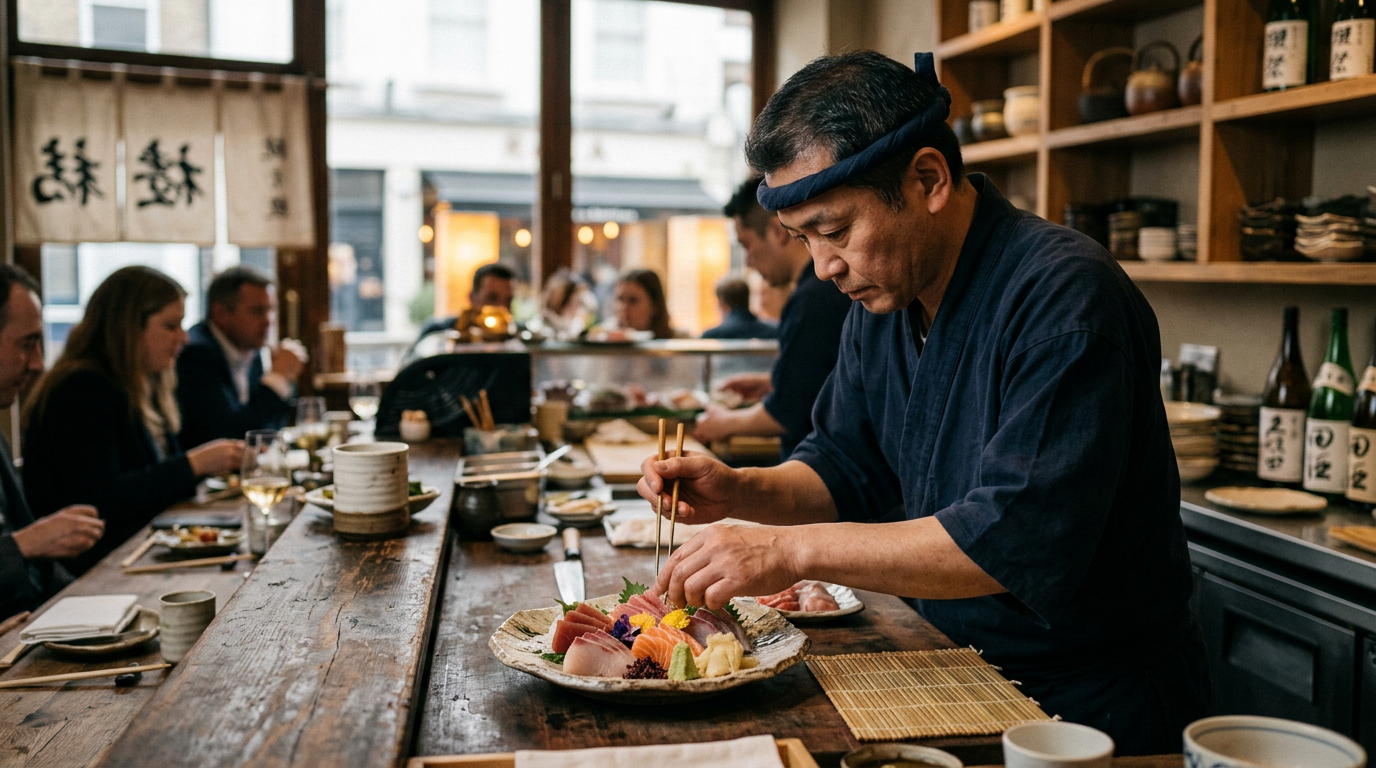
Why London Has One of Europe's Most Serious Japanese Dining Scenes
Ask most well-traveled food people which European city has the strongest Japanese restaurant scene, and the conversation usually starts with London and ends there. Paris has prestige. Berlin has energy. But for range, depth, and the specific quality that comes from a sustained Japanese community eating out regularly — London is, by some distance, the most serious city on the continent.
This is not an accident, and it is not simply a function of size. London is a large city, but so is Paris and so is Madrid, and neither has come close to matching what London has built over the past four decades. Understanding why requires looking at history, demographics, and an aspect of Japanese corporate culture that rarely comes up in food writing.
How It Started: The Corporate Footprint
The foundation of any serious immigrant food scene is people — specifically, people from that culture eating out regularly and demanding that restaurants meet the standards they grew up with. In London's case, that population arrived largely not as emigrants but as expatriates: employees of Japanese corporations that began establishing European headquarters in the city during the 1960s and 1970s.
Japan's postwar economic expansion produced a wave of major companies — trading houses, banks, electronics manufacturers, automotive firms — that needed a European base. London, as a financial capital with English as its working language, attracted a disproportionate share of them. By the 1980s, the Japanese business community in London was large, well-paid, and eating lunch and dinner in the city five days a week.
This matters because Japanese corporate expatriates are, as a group, particular about their food. They are not tourists passing through for a week. They are professionals living abroad for three to five years, often with families, who cook Japanese food at home and eat Japanese food when they go out. A restaurant that Westernizes its flavors or cuts corners on sourcing will lose this clientele quickly. The corporate Japanese community in London created a sustained, demanding customer base that rewarded authenticity and punished compromise — which is precisely the condition under which a serious food scene develops.
The Geography of Japanese London
The concentration of Japanese life in London settled, over decades, into a specific part of the city. The area around Piccadilly, Leicester Square, and stretching north toward Fitzrovia became the gravitational center — anchored by the Japan Centre, a food hall and cultural institution that has operated near Piccadilly for over fifty years and functions as a reliable indicator of where the community lives and shops.
This geography matters for restaurants. A cluster of Japanese residents and workers creates the conditions for a cluster of Japanese restaurants, which in turn creates competition, specialization, and the kind of peer pressure that keeps standards high. Restaurants in an area where Japanese customers walk past every day cannot survive on the tourist trade alone. They have to be good enough for people who know what good looks like.
From that original nucleus, the scene spread. Mayfair attracted the high-end end — omakase counters and kaiseki rooms that could charge accordingly. Soho absorbed the mid-range: ramen shops, izakayas, the kind of places you go on a Tuesday rather than a birthday. Marylebone, Notting Hill, and more recently Shoreditch have each developed their own pockets of Japanese cooking. The centre of gravity has shifted, but the density remains remarkable.
What "Serious" Actually Means Here
It is worth being precise about what distinguishes London's Japanese scene from that of, say, Amsterdam or Rome — both of which have perfectly respectable Japanese restaurants that would hold their own in most cities.
The difference is not just the number of restaurants, though London's count is high. It is the range of formats operating at a genuinely high level simultaneously. Most European cities with strong Japanese scenes do well at one or two categories — a city might have excellent ramen but thin izakaya options, or fine sushi but nothing approaching a serious kaiseki room. London, unusually, has depth across the full spectrum.
The ramen end of the market is genuinely competitive. Serious bowls — proper stocks, house-made noodles, regional specificity — are available across multiple neighborhoods, and the competition between operators has kept standards higher than in cities where one or two shops have the market to themselves.
The izakaya scene has matured in ways that took longer to develop. Early Japanese restaurants in London were almost entirely sushi-focused, partly because sushi was what British diners understood Japanese food to be. The broadening of the scene to include proper izakaya culture — charcoal grills, regional sake lists, small plates designed for sharing rather than impressing — reflects a population of diners that has learned to want more than a California roll.
At the top end, London has a handful of omakase counters and kaiseki rooms that would be taken seriously in Tokyo — not as curiosities, but as operations running close to the standard the form demands. These exist because the customer base to support them exists: Japanese expats, well-traveled food professionals, and a London dining culture that has, over decades, developed enough sophistication to appreciate what it is eating.
The Role of Japanese Chefs Who Stayed
A less discussed but equally important factor is what happened when Japanese chefs who came to London in the 1980s and 1990s — initially to staff the restaurants that served the expat community — decided to stay.
Several of the most significant figures in London's Japanese restaurant scene are chefs who arrived with the first wave of corporate Japan, trained in London's early Japanese kitchens, and eventually opened their own places. They brought knowledge, suppliers, and standards from Japan. They also adapted — over years of cooking in London, for London diners, with London suppliers — without losing the substance of what they had trained to do.
This creates a specific kind of restaurant that is different from both the tourist-facing approximation and the straight transplant: a genuinely London expression of Japanese cooking, shaped by the ingredients and the audience of the city, but rooted in real culinary tradition. These restaurants are often neither the most famous nor the most expensive in the city. They are frequently the most interesting.
Supply Chains and the Japan Centre Effect
A serious restaurant scene requires serious supply chains. You cannot run a credible edomae sushi counter if you cannot source aged fish, specific rice varieties, and the right soy. The density of London's Japanese community created enough consistent demand to support suppliers that simply do not exist in most European cities.
The Japan Centre operates a retail and wholesale side that has supplied London's Japanese restaurants for decades. Independent importers have built routes for specific products — particular regional sake, seasonal items, the kinds of ingredients that would otherwise require flying things in from Toyosu on a case-by-case basis. This infrastructure, built up quietly over fifty years, is invisible to most diners but essential to the quality of what ends up on the plate.
It is also a moat. A new Japanese restaurant opening in London has access to suppliers that a comparable operation in, say, Lisbon or Warsaw does not. The accumulated infrastructure of Japanese London is part of what makes London Japanese food as good as it is — and part of what makes it difficult for other European cities to close the gap quickly.
What London Does Not Do Well
Fairness requires acknowledging the gaps.
London's Japanese restaurant prices are high — not because the restaurants are gouging, but because London is an expensive city to operate in. Rent, staffing, and ingredients all cost more than in comparable European markets. The casual, inexpensive end of Japanese dining — the kind of lunch counter or neighborhood ramen shop where you eat well for ten pounds — is thinner than it should be, squeezed out by economics that favor either fast-casual chains or high-end destination dining.
The scene is also geographically uneven. Central London's Japanese restaurants are excellent. Further out, the options thin considerably. This is less a problem if you are visiting than if you are a London resident who happens not to live in Zone 1 or 2.
And the scene, for all its depth, is not static. Economic pressures post-pandemic, the loss of some long-running institutions, and the difficulty of finding trained Japanese kitchen staff in post-Brexit Britain have created real strain. Some of what made London's scene exceptional was built over decades by individuals and businesses that are irreplaceable. Their absence is felt.
Finding the Best of It
Washoku Guide lists 84 restaurants in London — one of the largest city counts on the guide, and a reflection of how much survives the curation process in a scene this developed. The listings span sushi counters and ramen shops, izakayas and teppanyaki rooms, and several operations that resist easy categorization.
The guide does not rank or rate. But if you are eating in London and want to understand which restaurants are operating closest to the traditions they represent, the London listings are a reasonable starting point — and the depth of what appears there is itself a measure of how seriously the city takes this food.
Frequently Asked Questions
Why does London have such a strong Japanese restaurant scene? The foundation is decades of Japanese corporate presence in the city. Major Japanese companies established European headquarters in London from the 1960s onward, creating a sustained, demanding community of Japanese diners that rewarded authentic cooking. Over time, this produced chefs who stayed, supply chains that deepened, and a local dining culture sophisticated enough to support the full range of Japanese formats.
Which area of London has the best Japanese restaurants? The historical centre is the area around Piccadilly, Soho, and Fitzrovia — where Japanese community life has been anchored since the Japan Centre opened nearby. Mayfair concentrates high-end omakase and kaiseki. Soho and Marylebone have the strongest mid-range options. Shoreditch has seen newer openings in recent years.
How does London compare to Paris for Japanese food? London is considerably stronger, particularly for range and authenticity. Paris has excellent high-end Japanese restaurants, but the Japanese expat community is smaller, the supply chains are thinner, and the breadth of formats — serious ramen, izakaya culture, affordable everyday Japanese — is much less developed than in London.
Are there good budget Japanese restaurants in London? This is London's relative weakness. The city's operating costs push Japanese restaurants toward either the fast-casual or the high-end, with less of the affordable mid-range that exists in Tokyo or Osaka. That said, the ramen and donburi end of the market has decent options at reasonable prices, particularly in Soho and the West End.
What makes a Japanese restaurant in London worth visiting? The same markers that apply anywhere: seasonal menus, evidence of technique, sourcing that goes beyond the generic, and — where the format demands it — a chef with genuine training in the Japanese culinary tradition they're working in. Washoku Guide's methodology explains the specific criteria the guide uses.
Washoku Guide lists 84 curated Japanese restaurants across London. Browse the London listings →
Restaurants featured in this guide
London
Heddon Yokocho
A vivid Showa-era ramen alleyway concept on Mayfair's pedestrianised Heddon Street — Japan Centre founder Tak Tokumine's love letter to Tokyo's retro yokocho bar culture.
London
Aki London
Contemporary Japanese fine dining in a Grade II-listed Marylebone bank, combining Kyoto-inspired cuisine, authentic Kobe beef, and an omakase sushi counter with a late-night DJ bar.
London
Ajimi
Reputable Japanese family-run restaurant in Acton serving authentic sushi, karaage and traditional dishes with a skilled kitchen and warm hospitality.
London
Haku Cafe & Izakaya
Ealing's Japanese café-izakaya affiliated with Hakutsuru Sake Brewery, offering simple Japanese food and sake in a kaku-uchi standing-bar style.
London
Abeno
Since 1993, Abeno has held the distinction of being Europe's first specialist okonomiyaki restaurant, where Osaka-born co-founder Elize Nakatani's recipes are cooked on individual teppan grills embedded in each table.
Continue reading
Best Sushi in Houston: 10 Authentic Spots (2026)
Houston’s sushi scene is much deeper than casual rolls and delivery menus. From Chef Hori’s Japanese-rooted restaurants to intimate omakase counters, hand roll bars, polished Galleria sushi rooms and modern Japanese dining, the city offers a wide range of serious sushi experiences. This guide highlights 10 Houston sushi spots worth knowing in 2026 — and explains what kind of sushi experience each one represents.
Where to Find Authentic Japanese Restaurants in New York City
New York City is one of the world’s great Japanese dining cities. East Village offers Little Tokyo-style restaurant culture, Midtown is strong for sushi, ramen and business dining, NoHo and SoHo have some of the city’s most serious omakase counters, and Brooklyn’s Japan Village brings Japanese food, groceries and casual dining together in one place. This guide explains where to look for authentic Japanese restaurants in NYC — and how to choose the right neighbourhood for sushi, ramen, izakaya, omakase, soba, yakitori and everyday Japanese food.
Where to Find Authentic Japanese Restaurants in Los Angeles
Los Angeles is one of the best cities in North America for Japanese food. Little Tokyo offers history and cultural depth, Sawtelle Japantown is a major West LA dining corridor, and Torrance and Gardena in the South Bay are home to some of the region’s most serious Japanese restaurants. This guide explains where to look for authentic Japanese restaurants in Los Angeles — from sushi and ramen to izakaya, soba, yakitori, omakase and everyday Japanese dining.